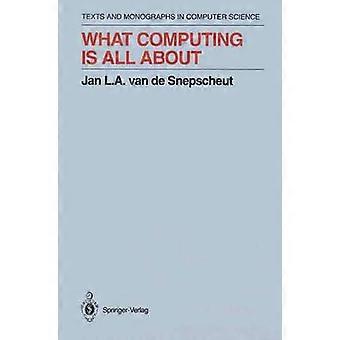
What Computing Is All About

107,12 €
+ 7,99 € Spedizione

What Computing Is All About
  • Marchio: Unbranded
Venduto da:

What Computing Is All About

  • Marchio: Unbranded

107,12 €

Disponibile
+ 7,99 € Spedizione

Politica di reso a 14 giorni

Venduto da:

107,12 €

Disponibile
+ 7,99 € Spedizione

Politica di reso a 14 giorni

Metodi di pagamento:

Descrizione

What Computing Is All About

1 What Is Computing All About? 1. - 2 Grammars 11. - 2. 1 Strings and Languages. - 2. 2 Grammars. - 2. 3 The Language Defined by a Grammar. - 2. 4 Bibliographic Notes. - 2. 5 Exercises. - 3 A Program Notation. - 3. 1 Introduction. - 3. 2 The Simple Statements. - 3. 3 The Conditional Statement. - 3. 4 The Iterative Statement. - 3. 5 Procedures. - 3. 6 Recursion. - 3. 7 Bibliographic Notes. - 3. 8 Exercises. - 4 Regular Expressions. - 4. 1 Right-Linear Grammars. - 4. 2 Transition Graphs. - 4. 3 Regular Expressions. - 4. 4 The Relation Between the Three Formalisms. - 4. 5 Equivalence Relations and Finite-State Automata. - 4. 6 Bridling Nondeterminism. - 4. 7 Bibliographic Notes. - 4. 8 Exercises. - 5 Integrated Circuits. - 5. 1 Semiconductor Physics. - 5. 2 Semiconductor Junctions. - 5. 3 MOS Transistors. - 5. 4 Combinational Circuits. - 5. 5 State-Holding Devices. - 5. 6 Sequential Circuits. - 5. 7 Variations. - 5. 8 Bibliographie Notes. - 5. 9 Exercises. - 6 Recursive Descent Parsing. - 6. 1 Top-Down Parsing. - 6. 2 Recursive Descent Parsing. - 6. 3 Limitations. - 6. 4 Lexical Analysis. - 6. 5 LR(k) Parsing. - 6. 6 Bibliographic Notes. - 6. 7 Exercises. - 7 The Halting Problem and Formal Proofs. - 7. 1 The Halting Problem. - 7. 2 Logic and Boolean Expressions. - 7. 3 Gödel's Incompleteness Result. - 7. 4 Cantor's Diagonal Argument. - 7. 5 Calculating with Boolean Expressions. - 7. 6 Formal and Informal Mathematics. - 7. 7 Bibliographic Notes. - 7. 8 Exercises. - 8 Some Programming Heuristics. - 8. 1 Omit a Conjunct. - 8. 2 Replace a Constant by a Variable. - 8. 3 Enlarge the Range of a Variable. - 8. 4 Reduce the Problem Size. - 8. 5 Random Examples. - 8. 6 Conclusion. - 8. 7 Bibliographic Notes. - 8. 8 Exercises. - 9 Efficiency of Programs. - 9. 1 A Lower Bound for Searching. - 9. 2 Analysis of Nested Loops. - 9. 3 The Constant Factor. - 9. 4 Conclusion. - 9. 5 Bibliographic Notes. - 9. 6Exercises. - 10 Functional Programming. - 10. 1 LISP. - 10. 2 Well-Founded Definitions. - 10. 3 More Examples of LISP Programs. - 10. 4 A LISP Interpreter Written in LISP. - 10. 5 A LISP Interpreter Written in Pascal. - 10. 6 Discussion. - 10. 7 Bibliographic Notes. - 10. 8 Exercises. - 11 Program Inversion. - 11. 1 Inversion of Programs. - 11. 2 Reversible Computations. - 11. 3 Circuits Built from Reversible Gates. - 11. 4 Reversible Gates Built from Billiard Balls. - 11. 5 DNA and Turing Machines. - 11. 6 Hot-Clock nMOS. - 11. 7 Bibliographic Notes. - 11. 8 Exercises. - 12 A Collection of Nice Algorithms. - 12. 1 Bresenham's Algorithm. - 12. 2 Computing the Transitive Closure. - 12. 3 Recording Equivalence Classes. - 12. 4 Minimization of Finite Automata. - 12. 5 Oil-Spread Algorithms. - 12. 6 Figure 6. - 12. 7 Huffman's Algorithm. - 12. 8 Bibliographic Notes. - 12. 9 Exercises. - 13 Concurrent Programs. - 13. 1 Mutual Exclusion. - 13. 2 A Subtle Mistake. - 13. 3 Communication via Channels. - 13. 4 Buffers. - 13. 5 Merging Two Streams. - 13. 6 Data Structures. - 13. 7 Matrix Multiplication. - 13. 8 Algorithms that Scale. - 13. 9 Bibliographic Notes. - 13. 10 Exercises. - 14 Implementation Issues: Compilation. - 14. 1 Translating from One Notation to Another. - 14. 2 Expressions. - 14. 3 Nomenclature. - 14. 4 Assignment Statement. - 14. 5 Parameters. - 14. 6 Flow of Control. - 14. 7 A Word About Big and Small. - 14. 8 Arrays. - 14. 9 Side Effects. - 14. 10 Peephole Optimization. - 14. 11 From Stack Machine to Register Machine. - 14. 12 Range Analysis. - 14. 13 Concurrency. - 14. 14 Assembly. - 14. 15 Bibliographic Notes. - 14. 16 Exercises. - 15 An Example of a Compiler. - 15. 1 The Program Notation Pascal-S. - 15. 2 The Stack Machine. - 15. 3 The Compiler. - 15. 4 Bootstrapping. - 15. 5 Bibliographic Notes. - 15. 6 Exercises. - 16 The Construction of a Processor. - 16. 1 ProcessorOrganization. - 16. 2 The ALU. - 16. 3 The Controller. - 16. 4 Multicomputers. - 16. 5 Bibliographic Notes. - 16. 6 Exercises. - A Answers to Some of the Exercises. - B Bibliography. Language: English
  • Marchio: Unbranded
  • Categoria: Computer e internet
  • Casa editrice/Casa discografica: Springer
  • Lingua: English
  • Data di pubblicazione: 2011/09/22
  • Formato: Paperback
  • ID Fruugo: 337914159-741573649
  • ISBN: 9781461276395

Consegna

Spedito entro 4 giorni

  • STANDARD: 11,11 € - Consegna tra lun 27 luglio 2026–gio 30 luglio 2026

Spedizione da Regno Unito.

Resi e cancellazioni

Resi

Facciamo del nostro meglio per assicurare che i prodotti che ordini vengano consegnati integralmente e secondo le tue indicazioni. Tuttavia, nel caso dovessi ricevere un ordine incompleto, oppure articoli differenti rispetto a quelli che hai ordinato, o se c'è qualche altro motivo per il quale non sei soddisfatto dell'ordine, puoi effettuare il reso dell'ordine, o qualsiasi prodotto incluso nell'ordine e ricevere un rimborso completo per gli articoli.

Visualizza la politica di reso completa

Cancellazioni

Hai il diritto di recedere dal tuo acquisto entro 14 giorni dal ricevimento dell'ordine senza dover fornire alcuna motivazione. Per esercitare facilmente il tuo diritto, puoi utilizzare il link "Annulla il mio ordine" nel piè di pagina di ogni pagina o all'interno del tuo account Fruugo alla voce "Ordini". Una volta esercitato il diritto di recesso, ti invieremo un'e-mail di conferma. Se il tuo ordine è già stato spedito dal venditore, ti forniremo le istruzioni necessarie per il reso al fine di garantire che il rimborso venga elaborato tempestivamente.

Visualizza la politica di cancellazione completa